








Credit card processing is the system that moves money from your customer’s card to your business bank account. It powers a massive share of global commerce, and it continues to grow. Industry data shows that the payment processing market is forecasted to expand from $82.10 billion in 2026 to $233.1 billion by 2035. As more money flows through these systems, even small differences in how you process payments can have a real impact on your costs, cash flow, and customer experience.
Updated for 2026, this guide breaks down how credit card processing works and how to choose the right provider for your business.
Key Takeaways
- Processing credit card payments involves three main stages: authorization, clearing, and settlement.
- The processor, card network, issuing bank, and acquiring bank each play a key role in moving data and funds.
- Processing fees vary by pricing model, with interchange-plus offering the most transparency into true costs.
- Businesses must follow strict security standards to protect card data or risk fines, higher fees, and potential breaches.
- Merchant accounts offer more control and stability, while payment aggregators are easier to start with but come with tradeoffs as you grow.
What Is Credit Card Processing?
Credit card processing is the system that moves transaction data and funds between a customer’s bank and a merchant’s bank. It handles the full lifecycle of a payment, from authorization to settlement, so businesses can accept card payments in person, online, or over the phone. Today’s shoppers increasingly prefer card payments when making purchases. A 2026 research from the Federal Reserve indicates that credit and debit cards account for 38% and 40% of consumer payments. So, what actually happens when a customer taps or enters their card? That process may feel instant, but there are some key players and steps behind the scenes.
Key Parties Involved in Credit Card Processing
While credit card payments occur almost instantly, there are multiple parties working behind the scenes to ensure the transaction runs smoothly:
- Customer (Cardholder) – The cardholder purchases goods or services from a business with a credit card.
- Merchant – The merchant is the business that receives payment for goods or services.
- Payment Processor – The payment processor connects the various stakeholders; it transmits payment data between merchants and banks to ensure smooth, efficient transactions.
- Acquiring Bank – Acquiring banks (aka acquirers) process card transactions for merchants and move funds from the customer’s issuing bank to the merchant’s account.
- Card Network – Card networks, also known as card brands (e.g., Visa, Mastercard, Amex), are credit card companies that set standards and processes for processing card payments.
- Issuing Bank – An issuing bank is the institution that issues customers’ credit and debit cards. It authorizes transactions, ensures funds are available, and manages accounts.
How Credit Card Payment Processing Works
How does credit card payment processing work? Here’s an overview of what happens when a customer uses their card to make a payment.
1. Authorization (1–3 seconds)
The customer presents their card (tap, insert, swipe, or online entry), and the payment request moves from your POS system or payment gateway to the payment processor, then to the card network, and finally to the issuing bank. Then, the issuing bank checks that the card is valid, funds or credit are available, and risk signals look okay. Finally, it sends back an approval or a decline.
Note: Security checks such as CVV and 3D Secure occur during this step, not as a separate stage.
2. Clearing (Batching)
At the end of the day (or at set intervals), your business sends a batch of approved transactions to the processor. The processor routes those transactions through the card networks, which pass them along to the appropriate issuing banks.
3. Settlement
At the payment settlement stage, issuing banks transfer the funds for approved transactions to the acquiring bank. The acquiring bank then deposits the money into your merchant account, minus the processing fees.
How Long Does It Take Businesses to Get Paid?
Most businesses receive funds from card transactions within 1–3 business days, though some providers offer same-day or next-day payouts. Timing depends on factors like batch cutoffs, weekends and holidays, your processor’s policies, and your business’s risk profile. Some providers, like Kurv, offer faster funding options to help improve cash flow.
What Are The Types of Credit Card Processing Equipment?
To accept credit card transactions, businesses require hardware and software to facilitate the process. The right solution depends on where and how you accept payments, so let’s explore the various types of credit card processing equipment and software your business may want to consider:
POS Systems
Point-of-sale (POS) systems are an all-in-one solution for accepting in-person payments. In decades past, POS systems were simple cash registers, but today’s best POS systems involve advanced software, credit card payments, and other modern payment solutions. They allow businesses to accept payments, track customer order history, offer rewards, and more. Some POS systems run on traditional computers or tablets (such as PCs and iPads), while others have dedicated hardware supplied by the POS provider.
Countertop Terminals
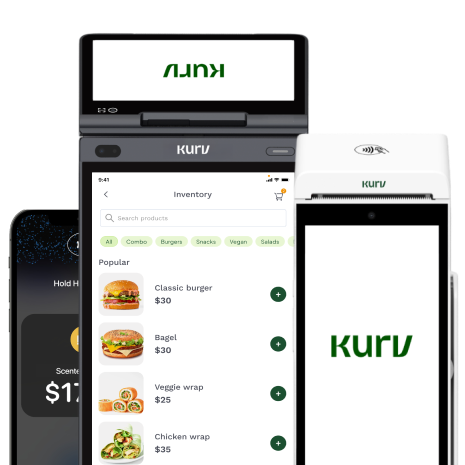
If you need the functionality of a POS system without any clunky hardware, a countertop terminal is the perfect solution. As their name suggests, countertop terminals rest on countertops, making it simple for customers to tap, insert, or swipe credit cards. Many countertop terminals, including Kurv’s all-in-one terminal, also feature interactive screens that allow customers to sign, enter PINs, request receipts, and more.
Mobile Card Readers and Handheld Terminals
Mobile card readers, along with handheld smart terminals, revolutionized the way many businesses accept payments. With a mobile card reader, merchants connect it to a mobile device via Bluetooth or a traditional cable. Merchants download a POS app, which allows them to control the card reader. This technology is ideal for businesses that need to accept credit card payments on a phone.
Contactless Payments, Tap to Pay, and QR Codes
Contactless payments let customers pay without swiping or inserting a card. Instead, they use near-field communication (NFC) to tap a card or device, scan a QR code, or complete a payment through a mobile wallet.
And adoption continues to accelerate, with Mastercard reporting that contactless payments accounted for more than 75% of transactions in their network in 2025. This adoption is fueled by faster checkout times, hygiene preferences, and strong adoption among younger consumers. Let’s take a closer look at these contactless payments.
- Tap to Pay (NFC) – Customers tap a contactless card or smartphone on a compatible device to complete a transaction in seconds. NFC powers most in-person contactless payments today.
- Mobile wallets – Tools like Apple Pay and Google Pay store card details securely on a phone or smartwatch, making checkout faster and reducing the need to carry physical cards.
- QR code payments– Customers scan a code with their phone to open a payment link or checkout page, commonly used in restaurants, retail, and service-based businesses.
Payment Gateways and Virtual Terminals
Payment gateways and virtual terminals empower your business to accept card-not-present transactions. To offer your customers ultimate payment convenience, you should offer more than just in-person payments.
Payment gateways are online portals, usually integrated into eCommerce stores, that allow customers to input their credit card details to process transactions. Many payment gateways offer extra features to enhance customer convenience, such as saving credit card details for future use.
On the other hand, virtual terminals allow staff members to enter customer credit card details to process payments. This payment tool is designed for accepting payments over the phone or via email when a customer can’t visit a physical retail store.
Understanding Credit Card Processing Fees
Credit card processing fees are often the largest cost tied to accepting payments, so understanding how they’re structured makes it easier to compare providers and avoid overpaying. At a high level, fees fall into two categories: non-negotiable costs set by the card networks and issuing banks, and negotiable fees set by your payment processor.
Common Fee Types
Non-negotiable fees:
- Interchange fees – Set by card networks and paid to the issuing bank for each transaction
- Assessment fees – Charged by card networks like Visa and Mastercard to support their infrastructure
Negotiable fees:
- Processor markup – The fee your payment processor adds on top of interchange and assessments, which is the main area you can negotiate
- Monthly fees – Ongoing account or subscription costs charged by some providers
- Chargeback fees – Fees applied when a customer disputes a transaction and initiates a chargeback
- Gateway fees – Charges for using a payment gateway to process online transactions
- PCI non-compliance fees – Penalties for failing to meet PCI security requirements
- Early termination fees – Fees for canceling your processor contract before the agreed term ends
Credit Card Processing Pricing Models
Now that you understand the various fees processors charge merchants, it’s time to look at payment processing fee pricing models. There are three major pricing models:
Flat-Rate Pricing
With flat-rate pricing, your business pays the same rate for payment processing regardless of card brand. However, pricing will still vary by payment type (i.e., there is usually a separate transaction fee for online and in-person payments). Flat-rate pricing is simple to understand but can be pricey as transaction volumes increase.
Tiered Pricing
Tiered payment pricing categorizes transactions into tiers: qualified, mid-qualified, and non-qualified. But how transactions are placed in each tier isn’t clear-cut because processors set their own criteria and can reclassify transactions based on factors you don’t see. As a result, merchants end up paying different rates for similar transactions, making this model the least transparent and most prone to hidden markups.
Interchange-Plus Pricing
Interchange-plus pricing is usually the most transparent and affordable pricing model. It charges merchants the interchange fee plus a pre-defined markup from the payment processor. This provides transparency and ensures payment service providers aren’t hiding excessive fee hikes.
Credit Card Processing Security and PCI Compliance
If you accept credit cards, PCI compliance isn’t optional. The Payment Card Industry Data Security Standard (PCI DSS) is a set of security rules that any business handling card data must follow to reduce fraud and prevent data breaches.
For most small businesses, complying with PCI standards and other payment laws means using secure systems, protecting cardholder data, and completing a basic self-assessment questionnaire (SAQ) each year. Working with a PCI-compliant payment provider helps offload much of the burden, but you’re still responsible for how your business handles and stores payment information. Falling out of compliance can lead to fines, higher fees, and increased risk in the event of a data breach.
Here are the core security technologies that support PCI compliance:
- Tokenization – Replaces sensitive card data with a unique token so real card details aren’t stored
- Encryption – Protects card data as it moves between systems, preventing interception
- EMV chips – Generate a unique code for each transaction, reducing counterfeit card fraud
- 3D Secure – Adds an extra authentication step for online transactions to verify the cardholder
Chargebacks and Payment Disputes
A chargeback is a forced transaction reversal initiated by the cardholder’s bank, typically after a customer disputes a charge on their statement. Chargebacks occur for several common reasons: suspected fraud, billing disputes, merchant errors (such as duplicate charges), or confusion about subscriptions and recurring payments.
Chargebacks can be expensive and disruptive. Beyond refunding the transaction, businesses often pay fees (typically $20–$100 per case), lose the product or service delivered, and risk higher chargeback ratios that can lead to penalties or even account termination. The best way to manage chargebacks is to prevent them in the first place, which includes using clear billing descriptors, providing responsive customer service, having accurate order tracking, and implementing transparent refund policies. Some merchant services providers also offer built-in chargeback prevention tools to help identify and resolve disputes early.
How to Choose a Credit Card Processing Provider
Looking for the right payment processor? Here are the factors to consider.
Merchant Account vs. Payment Aggregator
Merchant accounts give you a dedicated account and your own merchant ID, which means more control over transactions, pricing (often interchange-plus), and fewer surprises as you scale. Getting a merchant account is usually the better choice for established businesses or those with higher volume.
Payment aggregators (such as Square, Stripe, and PayPal) group multiple businesses under a single master account. They’re easy to set up and usually use flat-rate pricing, but they offer less control and may involve risks, such as account holds or sudden freezes.
Key Evaluation Criteria
Some of the criteria you can use to evaluate providers include:
- Pricing transparency – Are you getting clear interchange pass-through pricing or a bundled flat rate?
- Contract terms – Is it month-to-month or a long-term agreement with penalties?
- Equipment – Does the provider support modern hardware, such as mobile readers and Tap to Pay?
- Integrations – Will it connect cleanly with your accounting, CRM, or eCommerce tools?
- Security and PCI – Does the provider handle compliance, or are you responsible for it?
- Support – Can you reach a real person when something breaks? Is support 24/7?
- Funding speed – How quickly do funds hit your account?
Final Thoughts: Why Credit Card Processing Matters for Business Owners
Most businesses don’t think about payment processing until something goes wrong. A delayed payout, a surprise fee, or an account hold can quickly turn what feels like a simple transaction into a real operational problem. Understanding how processing works helps you spot these issues early and avoid them altogether.
When you know how fees are structured, how transactions move, and where providers make their money, you’re in a much better position to compare options and negotiate terms. That’s how businesses avoid overpaying, choose the right setup from the start, and keep more of what they earn.
It also makes day-to-day decisions easier. Whether you’re evaluating new tools, troubleshooting payment issues, or scaling into new channels, you’re not guessing. You understand what’s happening behind the scenes and can make decisions with confidence.
At the end of the day, the right payment setup should work quietly in the background while supporting your growth. And the right processor can make that a lot easier.
Frequently Asked Questions
How does a credit card transaction work step by step?
A credit card transaction moves through three stages: authorization, clearing, and settlement. During authorization, the payment is approved or declined in seconds after the issuing bank verifies the funds and assesses the risk. At the end of each day, approved transactions are batched and sent through the networks during clearing. Finally, in settlement, funds are transferred to your merchant account, minus fees. (See the diagram above for a visual breakdown.)
What security standards are required for credit card processing?
Businesses that accept cards must follow PCI DSS (Payment Card Industry Data Security Standard). In practice, that means completing a self-assessment questionnaire (SAQ), using secure systems, and relying on technologies like tokenization and encryption to protect card data. Most modern processors help handle a large portion of PCI compliance, but responsibility is shared.
How long does it take for a credit card payment to settle?
Most businesses receive funds within 1–3 business days. Some providers offer same-day or next-day payouts, depending on your setup, processing volume, and risk profile.
How much does credit card processing cost?
Costs typically range from about 1.5% to 3.5% per transaction, depending on how payments are accepted and your provider’s pricing model. Interchange-plus pricing is often the most transparent, while flat-rate pricing bundles costs into a single rate.
What is the cheapest way to take credit card payments?
For many businesses, using a merchant account with interchange-plus pricing is the most cost-effective option. It separates true card costs from processor markup, making it easier to control expenses.
What is the difference between a merchant account and a payment aggregator?
A merchant account gives you a dedicated account and more control over pricing, funding, and risk management. A payment aggregator groups multiple businesses under a single account, making setup faster but offering less control and a higher risk of account holds.
Do I need special equipment to accept credit cards?
It depends on how you sell. In-person businesses typically use a POS system or card reader, while online businesses need a payment gateway. If you want the simplest setup, options like Tap to Pay let you accept payments directly on your phone. Accepting credit card payments remotely is also possible with processors that offer virtual terminals, like Kurv.

