










For many small business owners, rising costs are no longer a temporary challenge — they’ve become the defining reality of running a business in 2026.
According to the U.S. Chamber of Commerce, 53% of small and medium-sized businesses (SMBs) now cite inflation as their biggest concern, and according to the MetLife & U.S. Chamber of Commerce Small Business Index, 70% say rising prices have directly impacted their operations over the past year. Another 34% say cost pressures are now the single biggest obstacle preventing business growth.
To better understand how the pressures of processing fees are affecting small businesses, and how consumers feel about convenience pricing at checkout, we surveyed 461 SMB owners and 1,007 consumers about rising payment costs, spending trade-offs, and payment behavior.
For many merchants, those fees are no longer just a routine cost of doing business. They’re quietly competing with marketing budgets, equipment upgrades, inventory purchases, hiring plans, and personal savings. In fact, our new research found that nearly half of SMB owners (47%) now spend more on credit card processing fees than they do on growing their business. What was once treated as a background operational expense, tied to payment processing and merchant services, is increasingly becoming a growth constraint.
Key Takeaways
- Over one in three SMB owners (37%) have made sacrifices due to card fees in the last year, and 40% of those have dipped into personal savings.
- Eighty-three percent of SMB business owners can’t state their effective processing rate from memory — meaning the vast majority are absorbing a cost they can’t clearly define.
- Nearly two-thirds of consumers (65%) are more willing to pay a convenience fee at a local business than a national retailer — and more than one in four say it won’t affect where they shop.
- Gen Z is 19% more likely than any other generation to pay convenience fees to support small businesses over national retailers.
- Nearly half of SMB owners (47%) spend more money on credit card fees than on growing their business.
Many SMB owners may be underestimating how much they’re actually spending on credit card processing. Only 17% of business owners said they could confidently state their effective processing rate from memory, while most either needed to check their statements or admitted they weren’t fully sure what they were paying.
We’ve consistently seen that many merchants don’t realize the true scale of processing costs until they step back and calculate the annual impact. When merchants actually sit down and calculate what they’re paying in credit card processing over the course of a year, the numbers can be eye-opening. Even businesses with competitive rates often pay 2% to 3% per transaction, and for higher-volume merchants, that can easily add up to tens of thousands of dollars annually.
How Credit Card Fees Are Slowing Small Business Growth
As inflation and rising operational costs continue to pressure small businesses, many SMB owners say credit card processing fees are now competing directly with investments in growth, staffing, inventory, and marketing. Our research found that for many businesses, the impact of processing fees extends far beyond monthly payment statements.
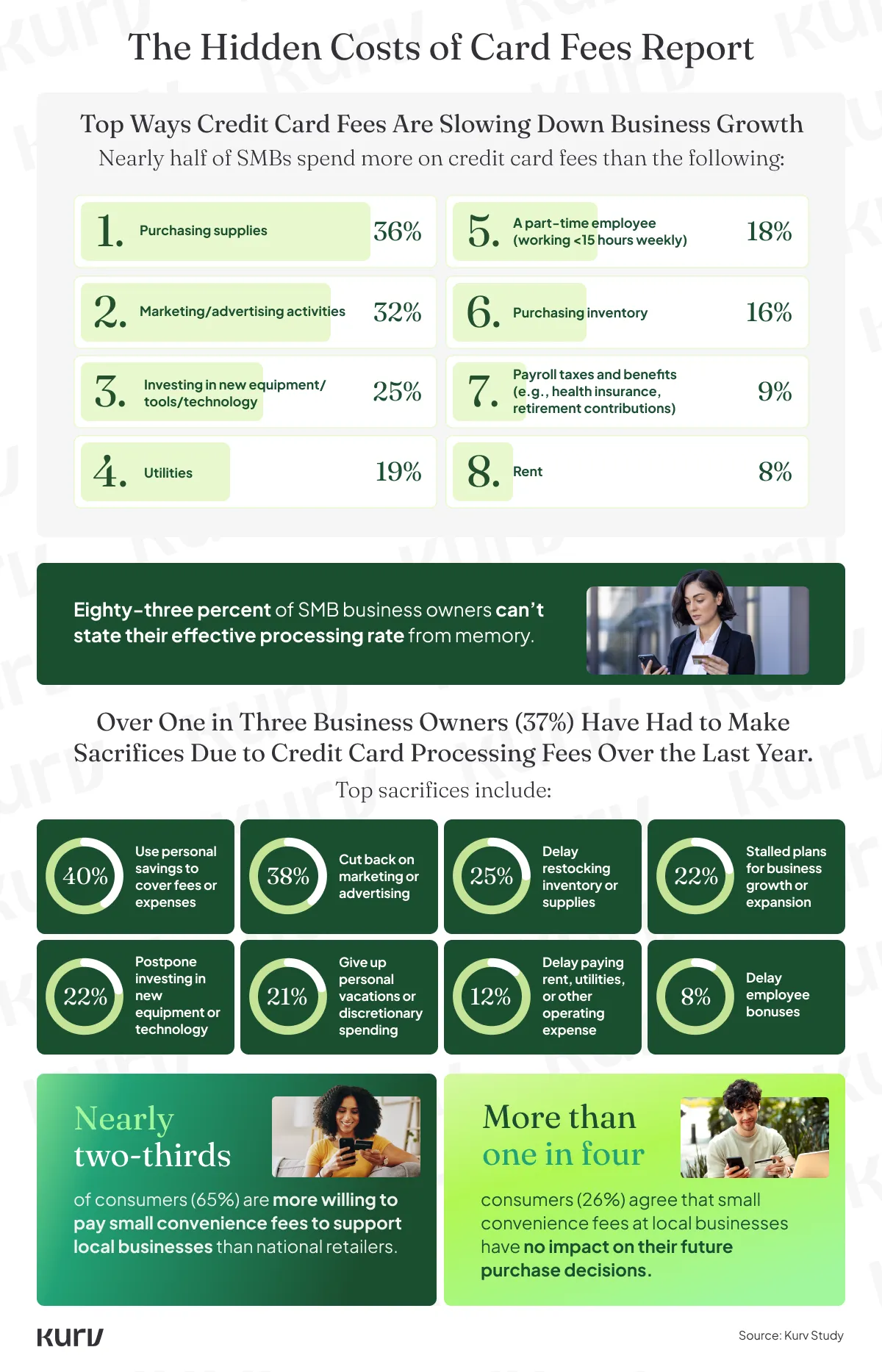
While these credit card processing fees paint a challenging picture for merchants, our research suggests a powerful counter-trend: consumer attitudes toward convenience fees are far more flexible than many small businesses realize.
When asked how they would respond to a small convenience fee at checkout:
- 51% would complete the purchase as intended
- 38% would switch payment methods to avoid the fee
- Only 6% would cancel the purchase entirely
Acceptance levels were even higher among younger consumers:
- Gen Z: 59%
- Millennials: 56%
- Gen X: 47%
- Baby boomers: 43%
Consumers were also more willing to pay convenience fees at local businesses than at national retailers:
- Gen Z: 74%
- Millennials: 67%
- Gen X & Baby Boomers: 59%
Overall, nearly two-thirds of consumers (65%) said they were more willing to accept small convenience fees at local businesses than at large national retailers. But Gen Z is leading this movement, being 19% more likely than any other generation to willingly absorb these fees specifically to protect small businesses over national giants.
We often tell our clients that many merchants overestimate how negatively customers will react to transparent fee structures.
Merchants often worry that adding a clearly communicated convenience fee will drive customers away, but in reality, we find that most consumers factor it into their purchase decisions at the time of purchase. Transparent pricing has become much more common, especially as processing costs continue to rise across industries. For many businesses, the bigger priority is making sure customers understand the fee upfront rather than trying to hide it.
At the same time, the research also highlights the importance of transparency. While some consumers said convenience fees would slightly affect future purchasing decisions, relatively few viewed them as a reason to stop shopping with a business entirely:
- Slight impact: 39%
- No impact: 26%
- Moderate impact: 19%
- Significant impact: 10%
- Completely avoid the business: 6%
That balance among transparency, customer expectations, and operational sustainability is increasingly shaping how SMB owners approach fee strategies, particularly when deciding among surcharging, cash discounting, and dual-pricing models.
The hidden reality of SMB trade-offs
For many SMB owners, processing fees tied to merchant services and payment processing are increasingly influencing day-to-day business decisions, particularly as inflation and rising costs already put pressure on margins.
Among SMB owners who said processing fees forced financial sacrifices over the past year, the most common responses included:
- Using personal savings to cover fees or expenses: 40%
- Cutting back on marketing or advertising: 38%
- Delaying restocking inventory or supplies: 25%
- Stalling business growth or expansion plans: 22%
- Postponing investments in new equipment or technology: 22%
The impact also varies significantly by industry. Professional service businesses were 75% more likely than eCommerce businesses to say processing fees outweighed investments in new technology or equipment. Meanwhile, eCommerce merchants were 21% more likely than professional-service SMBs to rely on personal savings to absorb rising payment processing costs.
Among SMB owners who made sacrifices due to fees, the most common trade-offs by business type included:
Professional services:
- Cut back on marketing or advertising: 44%
- Postpone investing in equipment or technology: 33%
- Use personal savings to cover expenses: 33%
Ecommerce:
- Use personal savings to cover expenses: 40%
- Cut back on marketing or advertising: 38%
- Delay restocking inventory or supplies: 25%
Despite the growing financial impact, many business owners still lack a clear understanding of what they are actually paying in processing costs through their merchant services providers and payment solutions.
Despite the growing financial impact, many business owners still lack a clear understanding of what they are actually paying in processing costs through their merchant services providers and payment solutions.
Our research found that:
- 36% would need to check their latest statement to find their effective rate
- 29% say they are unsure what their effective rate currently is
- 17% understand individual fees, but not the total effective rate
- Only 17% could confidently state their current rate from memory
From our perspective at Kurv, we are seeing more and more merchants prioritize pricing structures that feel clear, sustainable, and easier to communicate to customers.
A lot has changed in how merchants think about payment fees over the last decade. From what we’ve observed, businesses are moving away from pricing strategies that feel confusing or difficult to explain at checkout, and instead focusing on approaches that are more transparent for both the merchant and the customer. The goal now is to find a structure that makes financial sense for the business while still creating a straightforward experience for the people paying.
Choosing the Right Payment Processing Structure for Your Business
Evaluating standard payment options helps business owners identify where revenue leaks occur and how modern architectures can protect transaction margins.
Merchant services fees and costs explained
To demystify your monthly overhead, start with a clear look at how your baseline credit card processing fees are structured. A typical bill includes the following:
- Interchange: The wholesale fee set by card brands like Visa and Mastercard that goes directly to the cardholder’s issuing bank.
- Assessments: Small, direct costs that card brands collect for network maintenance.
- Processor markup: The negotiable fee your specific provider takes for routing the money.
Bundled billing strategies frequently obscure these lines, leaving 83% of SMB owners unable to trace their effective cost memory.
Payment processing fee comparison 2026: choosing the best setup to optimize your business
Your choice usually comes down to two types of providers, each of which dictates how you will be billed. Aggregated platforms offer fast setups but usually force you into flat-rate pricing. On the other hand, dedicated merchant accounts take longer to open but unlock access to lower-cost options, such as interchange-plus pricing or dual pricing as your sales grow.
To reclaim lost capital, you need to understand the trade-offs of each specific payment structure:
Flat-rate pricing:
- How it works: A static percentage and transaction fee (e.g., 2.6% + $0.10) for every purchase, regardless of the card type.
- The trade-off: Very simple to forecast, but can be a major cash leak as sales increase. Since basic cards cost much less to process at the wholesale level, flat-rate setups force you to overpay on simple transactions to cover premium rewards cards.
Interchange-plus pricing:
- How it works: The processor passes the card networks’ wholesale costs — interchange and assessment fees — directly to your statement at cost, then charges its own fixed markup on top (e.g., 0.4% + $0.08 per transaction).
- The trade-off: Highly transparent and cost-effective, ensuring you pocket the direct savings when customers pay with basic debit or credit cards. However, statements are detailed and confusing to decipher.
Dual pricing and cash discounting:
- How it works: Customers have two clear checkout options. They can opt to pay a lower (cash) price, or they can pay a standard price that already includes the cost of credit card processing, baked into the purchase price.
- The trade-off: Helps offset up to 100% of processing overhead, keeping growth capital in the business. However, it requires careful implementation: clear signage, upfront customer communication, and pricing displays that comply with card network rules and state regulations, which vary and carry real penalties if done wrong.
Protecting Your Margins Without Squeezing Your Customers
Beyond draining capital and restricting growth, rising transactional fees undermine trust and stifle confidence for small and medium-sized businesses. Understanding these complex networks requires merchants to step back and evaluate whether they have chosen the right processing structure to cut through the noise of confusing statement audits, unexpected markups, and high operational overhead.
To reduce that burden, SMBs must select processing configurations tailored to their unique sales channels and customer base.
Making an intentional choice—whether that means implementing interchange-plus transparency, card-present security alignments, or dual-pricing programs—allows business owners to directly protect their margins and improve overall cash flow planning based on real-world transaction patterns.
When transaction costs are quietly built into daily operations, businesses that focus on payment education, smart transaction routing, and active cost monitoring are best positioned to reclaim lost revenue and foster brand loyalty.
To learn about how Kurv’s transparent payment processing solutions and custom statement audits help SMBs identify and implement the right processing model for their business, please visit our pricing page.
Methodology
To explore how processing costs are impacting SMBs, we surveyed 461 small and medium-sized business owners in America. The data has a 95% confidence level and a low 5% margin of error. We also surveyed 1,007 consumers at a 95% confidence level and 3% margin of error. Because this exploratory research relied on self-reported data, respondents may have biases, and discrepancies may exist between their answers and their actual experiences.
Fair use statement
We’d love for you to share these findings, but please attribute to Kurv by sharing a link to this page.
Ready to Grow Your Business?
Apply and start accepting payments within a day


